
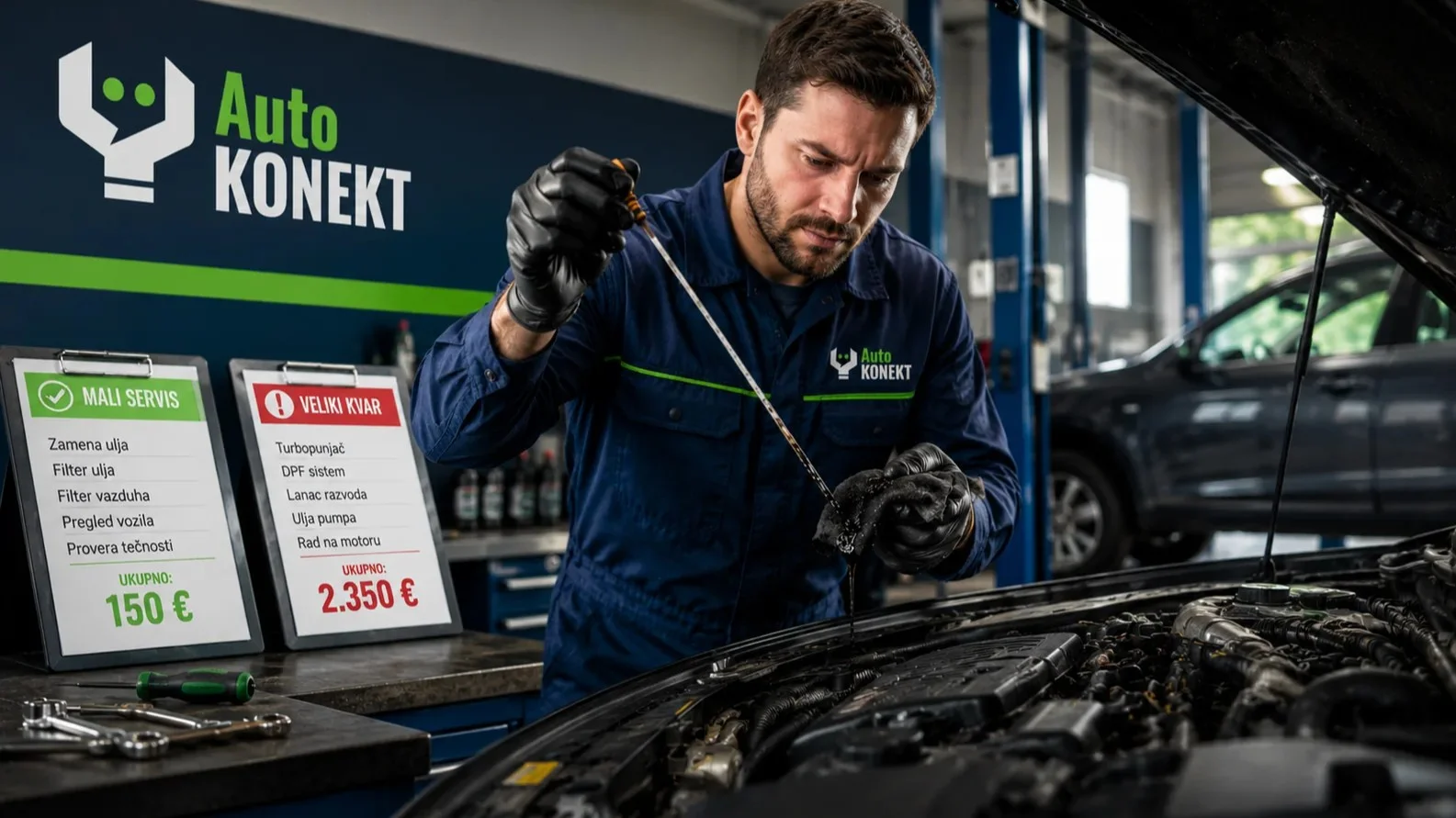
What Happens If You Skip an Oil Change Service? A €150 Service Can Easily Turn Into a Repair Costing Thousands
What Happens If You Skip an Oil Change Service?
“I can drive another 2,000 kilometers.”
“The oil still looks fine.”
“I’ll do it next month.”
These are probably the three most common phrases mechanics hear from drivers just before a major problem appears.
An oil change service is one of the simplest and least expensive maintenance procedures on a vehicle, yet it is also one of the most important. Despite this, many vehicle owners postpone changing their oil and filters, often believing that a few thousand kilometers beyond the recommended interval cannot make much difference.
The problem is that most failures do not happen overnight.
They develop gradually while the vehicle still appears to be operating normally.
In this article, we explain what happens when you skip an oil change service, which components are most at risk, and why preventive maintenance is far less expensive than any repair.
What Does an Oil Change Service Include?
For most vehicles, an oil change service includes:
Replacing engine oil
Replacing the oil filter
Checking fluid levels
Inspecting key vehicle systems
Looking for leaks and visible damage
Depending on the manufacturer, the service may also include replacing the air filter, cabin filter, or performing additional diagnostic checks.
At first glance, it may seem like a routine procedure.
In reality, it is the foundation of proper vehicle maintenance.
Why Is the Engine So Dependent on Oil?
A modern engine operates under extreme conditions.
Oil temperatures can exceed 100°C (212°F), while turbochargers in some engines spin at more than 200,000 rpm.
Engine oil performs several critical functions:
Lubricating moving parts
Reducing friction
Removing heat
Protecting against corrosion
Carrying away contaminants
The problem is that engine oil ages over time.
Regardless of quality, every oil gradually loses part of its protective properties during use.
As the oil ages, its ability to protect the engine decreases.
How Long Can You Delay an Oil Change?
This is one of the most common questions drivers ask.
The truth is that delaying an oil change by a few hundred kilometers or miles will usually not cause an immediate failure.
That is precisely why many drivers begin to believe that the service is not that important.
However, the issue is not one day or one trip.
The issue is cumulative wear.
If delaying maintenance becomes a habit, the risk of expensive repairs increases significantly.
The Most Common Problems Caused by Delayed Oil Changes
Turbocharger Wear
A turbocharger depends on a constant supply of clean, high-quality oil.
Degraded oil increases friction and temperature, which can accelerate wear on turbocharger bearings.
Repairing or replacing a turbocharger often costs between €800 and €2,000.
Oil Passage Blockages
Over time, oil accumulates soot, metal particles, and other contaminants.
These deposits can reduce oil flow through the engine and increase wear on critical components.
DPF and EGR System Issues
In modern diesel engines, poor maintenance can indirectly place additional stress on emission-control systems.
The result may be costly cleaning procedures or component replacement.
Accelerated Engine Wear
The worst-case scenario occurs when an engine operates for extended periods with oil that no longer provides adequate protection.
Such damage often requires major mechanical repairs.
The Problem Is Not Just the Oil
One important aspect is often overlooked.
During a routine service, a mechanic does much more than replace oil.
The vehicle is also inspected.
Regular servicing often reveals:
Early oil leaks
Worn brake components
Damaged hoses
Suspension issues
Early signs of mechanical problems
When you skip a service, you also miss the opportunity to identify problems while they are still inexpensive to fix.
Why Do Drivers Actually Delay Maintenance?
Most drivers do not postpone maintenance because they do not care about their vehicle.
The most common reasons are:
They forget when the next service is due
They are unsure of the correct maintenance interval
They do not have time to call multiple repair shops
They do not know what the service will cost
They have not found a repair shop they fully trust
In other words, the real issue is often not maintenance itself.
The issue is maintenance planning.
How to Prevent a Small Service from Becoming a Big Problem
The most effective solution is proactive maintenance planning.
Just as we plan vehicle registration renewals, vacations, or business trips in advance, vehicle maintenance should also be scheduled proactively.
This is where a digital approach to vehicle maintenance becomes valuable.
AutoKonekt was created to make that process easier.
Through the platform, users can:
Track vehicle maintenance intervals
Receive reminders for upcoming services
Find verified repair shops
Plan maintenance more efficiently
Maintain a complete service history
The goal is not only to keep the vehicle running today.
The goal is to reduce long-term repair costs and preserve the vehicle's value over time.
Conclusion
An oil change service may not be the most exciting part of vehicle ownership, but it is one of the most important.
Your vehicle often provides warning signs long before a serious failure occurs. The problem is that many drivers ignore those signs until they become expensive.
That is why the cheapest repair is usually the one you prevent.
And the first step is not visiting a repair shop after a warning light appears.
The first step is planning maintenance before a problem develops.
Frequently Asked Questions (FAQ)
How long can I delay an oil change?
It is best to follow the maintenance intervals specified by your vehicle manufacturer. Significant delays increase the risk of engine wear.
What is replaced during an oil change service?
Typically, engine oil and the oil filter are replaced, while other filters and consumables may be replaced if necessary.
Can old oil damage a turbocharger?
Yes. Oil quality directly affects turbocharger lubrication and cooling.
How much does an oil change service cost?
Depending on the vehicle and engine type, it typically costs between €100 and €250.
Is it worth delaying an oil change for a few thousand kilometers?
It may seem like a short-term saving, but it significantly increases the risk of much more expensive repairs in the future.