
The Shortage of Automotive Technicians Is No Coincidence – Here's Why Some Repair Shops Don't Have This Problem
Whether you run a small independent repair shop or a large authorized dealership service center, sooner or later you will face the same problem – a shortage of skilled technicians.
How do you find a good automotive technician?
More importantly – how do you keep them?
At the same time that some workshops struggle to find workers, others maintain stable teams that stay for years.
Why is that?
MAIN CAUSES OF THE SHORTAGE OF AUTOMOTIVE TECHNICIANS AND AUTO ELECTRICIANS
CAUSE 1: Lack of Interest Among Younger Generations
It is a harsh but undeniable fact that high school graduates in 2026 show significantly less interest in entering skilled trades than previous generations. This trend affects all vocational professions, but statistics suggest it is particularly severe in the automotive industry.
The public generally undervalues tradespeople and often perceives mechanics as dishonest. In addition, automotive repair is commonly viewed as dirty, physically demanding work that does not pay well.
Unfortunately, there is some truth behind these perceptions. Automotive technicians often work in challenging environments, and the job can be physically demanding.
CAUSE 2: An Aging Workforce
Fewer young people are choosing to become automotive technicians at a time when many experienced professionals are approaching retirement.
The average age of an automotive technician in Serbia is over 40, with many workers already in their 50s and 60s. When these experienced professionals retire, they take decades of valuable knowledge and expertise with them.
CAUSE 3: Inadequate Training and Educational Opportunities
Today, apprenticeship programs are relatively rare and are primarily offered by dealership networks. Even then, technicians enrolled in such programs frequently complain about insufficient classroom education, poor mentoring, and limited career advancement opportunities.
In many cases, dealerships provide only enough training to get new technicians operational. They are often assigned low-skill tasks such as oil changes, fluid replacements, tire repairs, and workshop cleaning. As a result, many leave the industry due to low wages, high tool costs, inadequate training, and limited opportunities for advancement.
Vocational school curricula are not always aligned with the needs of modern repair facilities. Automotive education faces a significant challenge: balancing training on older technologies with instruction on the latest vehicle systems.
Independent workshops typically service older, out-of-warranty vehicles and therefore need technicians with deep knowledge of traditional automotive systems. Dealerships, on the other hand, require technicians capable of diagnosing and repairing the latest electronically advanced vehicles.
Consequently, many graduates leave school with only limited knowledge of both worlds and mastery of neither.
CAUSE 4: Wage Disparities
Many automotive technicians feel underpaid and undervalued considering the level of expertise required in the profession.
Entry-level wages often fail to reflect the necessary education, certifications, and investment in tools. In many workshops, starting hourly rates are only slightly above minimum wage—sometimes lower than what employees can earn in fast-food restaurants.
It is difficult to justify the cost of education and substantial tool investments when starting salaries remain so low.
As a result, many talented individuals seek better-paying opportunities in other industries, while a significant number choose to work abroad. Additionally, the physically demanding nature of the profession can lead to burnout, pushing even more workers away from the industry.
CAUSE 5: Dissatisfaction with Organization and Working Conditions
Poor work organization—where everyone does everything, or where certain individuals receive undeserved privileges—can create frustration and dissatisfaction.
Insufficient tools and equipment can be particularly problematic, especially in environments where technicians are paid based on productivity. Without proper tools, technicians waste valuable time improvising solutions.
Poor scheduling practices, such as double-booking appointments, create additional pressure. Over time, the accumulation of these negative factors creates a toxic work environment and leads to chronic dissatisfaction among skilled employees.
In many service centers, the problem is not compensation—it is organization.
WHAT MOST REPAIR SHOPS DO
Most service centers are faced with one of two choices:
Increase wages, sometimes beyond what the business can sustainably afford.
Operate with fewer technicians than necessary.
Neither option provides a long-term solution.
Employee dissatisfaction often returns after a few months, even following a pay increase. Operating with insufficient staff places additional pressure on the remaining technicians and inevitably affects service quality, which customers eventually notice.
FOUR MEASURES AUTOMOTIVE REPAIR SHOPS CAN TAKE
Although the problem is difficult to solve, there are several steps that can significantly improve the situation.
1. Invest in Young Talent – Build Partnerships with Schools
The first opportunity to connect with future employees—whether technicians or other staff members—is through cooperation with vocational schools.
This collaboration can take place through internship programs or dual education systems.
These partnerships allow service centers to identify promising future employees while giving students the opportunity to experience the workplace, meet future colleagues, and evaluate potential employers.
Training and Mentorship
Whether operating a large dealership workshop or a small independent repair shop with only a few technicians, it is essential to maintain a positive attitude toward onboarding and training new employees.
Mentorship should be treated as an equally important responsibility alongside vehicle reception, diagnostics, repairs, and other operational tasks.
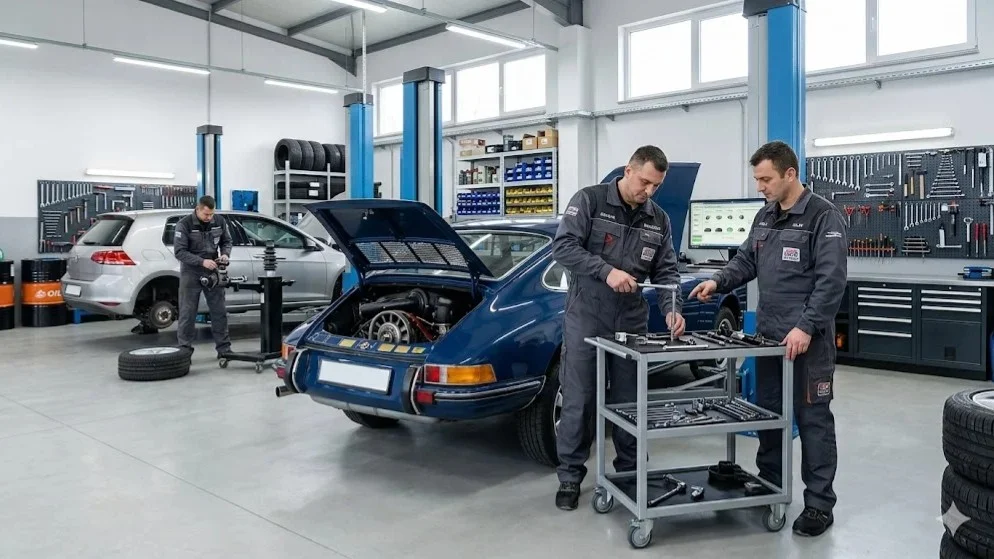
2. Improve the Working Environment
Research in organizational psychology, ergonomics, and management consistently demonstrates that workplace conditions, appearance, and cleanliness significantly impact employees.
These effects are commonly measured through productivity, job satisfaction, health, and motivation.
Studies show that physical workplace conditions—including cleanliness, workspace organization, lighting (natural light can improve productivity by up to 18%), noise levels, and ergonomics—have a direct and measurable impact on:
Employee productivity
Job satisfaction
Health and absenteeism
Motivation and engagement
Creating a cleaner, more organized, and more pleasant workplace is often one of the most cost-effective investments a service center can make.
3. Improve Work Organization
A skilled technician will eventually leave any workplace characterized by chaos and poor organization.
Repairs are interrupted midway to accommodate a "more important" customer. Multiple vehicles are booked into the same service slot. Priorities constantly shift.
Better organization can be achieved by improving several key operational areas:
Scheduling
Effective planning starts with a structured appointment system.
Initially, implementation may be challenging, but workshops can gradually reduce the portion of capacity reserved for walk-in customers while increasing capacity dedicated to scheduled appointments.
The goal should be reaching a point where at least 80% of customers arrive through scheduled appointments.
Planning
Once a reliable scheduling system is established, workshops can improve overall operational planning.
This enables better vacation management, employee scheduling, seasonal preparation, and resource allocation.
Customer Communication
Customer communication often consumes a significant portion of a workshop's most valuable resource: time.
Today, specialized service providers can handle part or all customer communication processes, including appointment management, upselling opportunities, collections, customer satisfaction follow-ups, and complaint handling.
Regular Breaks
Proper meal breaks and scheduled coffee breaks contribute positively to employee productivity, health, and overall well-being.
Reliable Suppliers
Efficient scheduling and planning become significantly more effective when supported by reliable parts suppliers capable of delivering quality components on a just-in-time basis.
This reduces delays, minimizes customer communication issues, and improves operational efficiency.
Quality Tools and Equipment
Many technicians consider this factor a top priority.
High-quality tools and equipment primarily improve workplace safety but also significantly increase efficiency and productivity.
4. Compensation – A Clear and Transparent Pay Structure
Many successful repair shops utilize a combination of fixed salaries and performance-based bonuses.
This approach motivates employees and gives them a sense of control over their earnings.
Establishing the right balance between fixed and variable compensation is critical. There is no universal bonus system, but having a structured incentive plan is far better than having none at all.
Service centers should continuously evaluate and adjust their compensation models to find the optimal solution for their workforce.
Most importantly, once a compensation system is adopted, it must be applied consistently—regardless of whether management occasionally feels a particular salary is "too high" or "too low."
The calculation method should also be transparent and easily understood by every employee affected by it.
THE FUTURE OF AUTOMOTIVE REPAIR SHOPS
There is no technician who does not know several other technicians.
No recruitment agency, employment service, or online job platform can outperform a trusted recommendation from a respected colleague.
A satisfied technician is much more likely to recommend their employer to other skilled professionals. Likewise, employers tend to trust referrals from their existing employees.
The vehicle maintenance industry will continue to grow.
Vehicles are becoming increasingly complex, and the demand for highly skilled technicians will only increase.
In the coming years, the biggest challenge for repair shops will not be how to find customers.
The much simpler—and more difficult—question will be:
Who will do the work?